Showing posts with label LEGO. Show all posts

Sunday, September 16, 2018

LEGO Ideas - Adventure Time

I bought this set last year at Toys R Us. And just like Toys R Us, Adventure Time recently wrapped up it's 10th and final season with a one-hour special episode. I'm no longer a child, but you're never too young to enjoy walking around a toy store, playing available toys, just browsing. The same with Adventure Time, it's a very grown up show disguised as a kid's show. The show ending is like losing a best friend you've watched over the years, but the whole premise of the show is that there will always be adventures. The spirit of adventure is passed on to the next generation and spiritual successors of the main characters. No matter how different those adventures are, the themes are the same at their core and that's what makes them fun.

The set features Finn, Jake, BMO, Ice King, Gunter, Marceline, Princess Bubblegum, and Lady Rainicorn.

21308 - LEGO Ideas - Adventure Time

Finn and his best friend and adopted brother, Jake, roam the Land of Ooo, righting wrongs and battling evil. Along the way, they make friends with a whole range of wacky characters such as Princess Bubblegum, Lady Rainicorn and Marceline the Vampire Queen. They also have to deal with the grumpy Ice King, the mean ruler of the Ice Kingdom, who really needs to chill out.

The animated television series created by Pendleton Ward has achieved both cult status and widespread popularity, and is now also the 16th set in the LEGO Ideas series.

Sets released under LEGO Ideas are originally made by fans and submitted to LEGO. The LEGO Ideas community votes on submitted ideas as a supporter. Product ideas that achieve over 10,000 supporters will be reviewed by the LEGO group and may even have a set released based on the fan idea.

Music:
Jake - Bacon Pancakes (Remix)
Adventure Time Ending Them (Come Along With Me) - Ashley Eriksson


I'm done.

Wednesday, July 4, 2018

LEGO Architecture - Statue of Liberty

"True independence and freedom can only exist in doing what's right."

This set took about 6 hours to make spread across two days. The Statue of Liberty was recently featured in the LEGO Architecture - New York City Skyline series in 2016, comprising of a several LEGO blocks a micro green minifig. This 2018 set is the most detailed LEGO Architecture set so far at 1,685 pieces.

21042 - LEGO Architecture - Statue of Liberty

The Statue of Liberty was a gift of friendship from the people of France to the United States, and has since become a universal symbol of freedom and democracy throughout the world. Dedicated on the 28th of October 1886, she was often the first thing people saw as they sailed into New York’s harbor to start a new life in America.

Music:
Medal of Honor: Allied Assault - Main Theme
Medal of Honor: Pacific Assault - Main Theme
Medal of Honor: European Assault - Dogs of War (Main Theme)


I'm done.

Wednesday, April 25, 2018

LEGO Star Wars - R3-M2 and DJ Minifigures

Found both of these at Toys R Us. I'll miss this store when it closes.

R3-M2 was an R3-series astromech droid that served the Alliance to Restore the Republic. It is a droid character created for Rogue One: A Star Wars Story.

DJ (short for "Don't Join") is a human male slicer in the galaxy during the war between the Resistance and the First Order. He first appeared on Episode VIII: The Last Jedi.


I'm done.

Sunday, April 1, 2018

LEGO Star Wars - Millenium Falcon in 2 Minutes (Easter Edition)

Don’t know how, but I found the LEGO Star Wars Millenium Falcons on sale at 30% off. So I bought two: 1 to build and 1 as a future investment.

Here's the time lapse build of the set.


Saturday, December 30, 2017

LEGO Architecture - LEGO® House

My last video for 2017.

Even though this is officially part of the LEGO Architecture line, the set is sold exclusively by surrounding stores in Billund, Denmark starting in 2017 commemorating the opening of the LEGO House in September.

Construction started in 2014. The building officially opened in September 28th, 2017. The building functions as part public art piece, tourist attraction, LEGO store, cafe, and with roughly 20,000 square feet set aside for open space.

21037 - LEGO Architecture - LEGO® House

From the very beginning, the ambition with LEGO® House was to create a unique and inspiring, hands-on and minds-on experience, where LEGO fans of all ages could learn all
about the company and the endless play possibilities offered by LEGO bricks.

It was quickly agreed that the right location would be in the center of Billund. This is where the LEGO story started almost 90 years ago and the town still serves as the global
headquarters of the LEGO Group. Then came the task of finding a partner who could design a distinctive building that would become an integral part of the LEGO House experience.

The idea for the LEGO® House was to create “a cloud of interlocking LEGO bricks... a literal manifestation of the infinite possibilities of the LEGO brick.” 21 white bricks would be stacked on top of each other and be crowned by the Keystone, which would be inspired by the classic eight-knob LEGO brick.

These huge bricks will not only form internal spaces for LEGO House activities, but also create a covered public square and a series of interconnected terraces and playgrounds for people to investigate and enjoy. In this way, the LEGO House will be enjoyed both by fans who came to experience the LEGO story and by local citizens and visitors to the town of Billund.


I'm done.

Friday, December 15, 2017

LEGO Architecture - Solomon R. Guggenheim Museum (2017)

They remade the Solomon R. Guggenheim Museum set from 2009. this time with more parts and about 3 times as big.

In June 1943, Frank Lloyd Wright was asked by Hilla Rebay, the art advisor to Solomon R. Guggenheim, to design a new building to house Guggenheim’s four-year-old Museum of Non-Objective Painting.

The project would evolve into a complex struggle pitting the architect against his clients, city officials, the art world and public opinion. It would take over 15 years, 700 sketches and seven complete sets of working drawings before Wright’s vision would be realized and the Solomon R. Guggenheim Museum would open its doors for the first time in 1959. By then both Guggenheim and Wright had died.

The location of the Guggenheim Museum on Fifth Avenue between 88th and 89th Streets is not accidental. Its proximity to Central Park was key; as close to nature as one can get in New York, the park affords relief from the noise and congestion of the city.

Nature not only provided the museum with a respite from New York’s distractions, but also lent it inspiration. The Guggenheim Museum is an embodiment of Frank Lloyd Wright’s attempts to utilize organic forms in architecture.

But even as it embraced nature, Wright’s design also expresses his unique take on modernist architecture’s rigid geometry. The building is a symphony of triangles, ovals, arcs, circles and squares.

Wright dispensed with the conventional approach to museum design, which led visitors through a series of interconnected rooms. Instead, he whisked people to the top of the building via elevator and led them downward at a leisurely pace on the gentle slope of a continuous ramp. The open rotunda afforded viewers the unique possibility of seeing several bays of work on different levels simultaneously.

The building itself has often been called the most important piece of art in the Guggenheim collection.


I'm done.

Sunday, November 5, 2017

Brick Montage (2011-2016)

Here are all the LEGO Architecture, Nanoblock, McFarlane Construction, and one Kubros buildable figure I've built from 2011 to 2016.


  • 17 LEGO Architecture sets
  • 16 Nanoblock sets
  • 3 McFarlane Construction sets (The Walking Dead, Game of Thrones)
  • 1 Kubros buildable figure (Ezio)


  • 2011:
    • 21006 - LEGO Architecture - The White House
  • 2013:
    • 21003 - LEGO Architecture - Seattle Space Needle
    • 21008 - LEGO Architecture - Burj Khalifa
  • 2014:
    • NBC_017 - Nanoblock - Grand Piano
    • NBH_004 - Nanoblock - Eiffel Tower
    • NBH_033 - Nanoblock - Great Pyramid of Giza
    • 21018 - LEGO Architecture - United Nations Headquarters
    • 21015 - LEGO Architecture - Leaning Tower of Piza
    • 21019 - LEGO Architecture - The Eiffel Tower
    • NBCC_001 - Nanoblock - Hello Kitty
    • NBA_004 - Nanoblock - Chrysler Building (USA Exclusive)
    • NBC_099 - Nanoblock - Santa Claus and X'mas Tree
    • NBC_100 - Nanoblock - Snowman and X'mas Tree
    • NBC_014 - Nanoblock - Reindeer
    • NBH_077 - Nanoblock - X'mas Tree Set
  • 2015:
    • NBH_010 - Nanoblock - Neuschwanstein Castle
    • ML_027 - Nanoblock (mamelog) - ❤Love❤
    • ML_030 - Nanoblock (mamelog) - Thank You
    • 21000 - LEGO Architecture - Willis Tower (Sears Tower)
    • 21001 - LEGO Architecture - John Hancock Center
    • 21002 - LEGO Architecture - Empire State Building
    • 21016 - LEGO Architecture - Sungnyemun
    • NBH_009 - Nanoblock - Moai Statues of Easter Island
    • 21023 - LEGO Architecture - Flatiron Building
    • 21020 - LEGO Architecture - Trevi Fountain
    • 21022 - LEGO Architecture - Lincoln Memorial
    • 21024 - LEGO Architecture - Louvre
    • NBH_008 - Nanoblock - Taj Mahal
    • NBH_011 - Nanoblock - Kinkaku-ji
    • 14526 - The Walking Dead Construction Sets - The Governor's Room
  • 2016:
    • NBPM-001 - Nanoblock - Pokémon (Pikachu)
    • 21026 - LEGO Architecture - Venice
    • 14649 - The Walking Dead Construction Sets - Wolves Not Far
    • 21027 - LEGO Architecture - Berlin
    • 21011 - LEGO Architecture - Brandenburg Gate
    • 19391 - Game of Thrones Construction Set - Iron Throne Room
    • 18 | Kubros - Ezio
I'm done.

Wednesday, October 18, 2017

LEGO® House (2014 Special Edition)

This special edition set was only sold by surrounding stores in Billund, Denmark in 2014 to promote the LEGO House. It's designed to fit in with the Architecture theme, but not an official part of it.

Construction started in 2014. The building officially opened in September 28th, 2017. The building functions as part public art piece, tourist attraction, LEGO store, cafe, and with roughly 20,000 square feet set aside for open space.

Billund - the Capital of Children

LEGO® House is being built at the heart of Billund and is an important step in the vision of developing Billund into a Capital of Children. The dream is to make Billund a venue for children as well as a centre for spreading knowledge about creativity, play and learning.

LEGO House will offer Billund's city centre a unique attraction, create new and exciting spaces to meet and help make the city more vibrant.

Around LEGO House, new public spaces for play, staying and commercial activities will be created. Inside the building, a large, covered space with easy access will create a rich and interesting focal point for citizens of Billund, visitors and guests of LEGO House.

LEGO House is an attraction in itself, and the building's rooftop terraces will be accessible both from within and from the outside, creating completely new environments and vantage points.

Architectural idea

The architectural main purpose is to organise the building functions into 21 white bricks, enclosing the indoor space, stacked on top of each other and completed by the fantastic Keystone Gallery, which is inspired by the classic eight-knob LEGO® brick.

Visitors will experience the brick concept throughout the building.

On the ground floor, the bricks around the indoor activity space will feature all functions. Spectacular front stairs will lead up to all the experiences with a bridge, ramps and stairways connecting the various bricks.

LEGO House features disabled access and will be easily accessible for all. Regardless of where the guests are in the house, interior windows and clear lines of sight ensure that they always know where they are, where they come from, and where they are going.


I'm done.

Friday, September 29, 2017

LEGO Architecture - Solomon R. Guggenheim Museum (2009)

It's one of several earlier LEGO Architecture sets in the Architect series that came out in 2009. It's also one of many Frank Lloyd Wright LEGO Architecture sets. The set has been retired.

"The commission for the museum building first came to Frank Lloyd Wright in 1943 from Hilla Rebay. The Baroness von Rebay was the curator of the 'non-objective' painting collection she had encouraged Solomon R. Guggenheim to purchase. Solomon R. Guggenheim desired an architectural environment in which to present these new works that would be as revolutionary as the paintings in his collection themselves."

"Guggenheim was always supportive of Wright, but his death in 1949, just six years after the project was begun, dealth a severe blow to the plans. It took thirteen years of patient struggle on the part of Wright to finally see his building start in construction, and even through the construction stages - from 1956 to his death in 1959, six months before the museum opened - the struggle waged on. During the sixteen years that this commission dragged on, it was to prove to be the most difficult and the most time-consuming of all Wright's work."

"The building that stands in New York today is very different from those early studies of 1944. The general concept of the building - one continuous ramp - remains, but with the acquisition of more parcels of property on the site and with the change of the program of the museum itself, different architectural solutions were required along the way. Seven complete sets of working drawings were prepared and finally, on August 16, 1955, ground was broken and construction began."

"When the corner at 88th Street was acquired in 1951, the spiral ramp was shifted back to the south. After this last shift was made, Wright, in response to the changing administrative requirements of the museum, suggested the constrction of a tall building behind the museum for a historical gallery, staff offices, workrooms, and storage. Rising behind the museunm would be an eleven-story structure. It was this 1951 design by Wright that served as precedent for the 1992 addition of a 'backdrop' building behind the museum."


I'm done.

Monday, September 4, 2017

LEGO Architecture - Rockefeller Center

It's one of several earlier LEGO Architecture sets in the Architect series. The set has been retired.

Rockefeller center is a complext of 19 commercial buildings covering 22 acres (89,000 square meters) betwen 48th and 51st streets in New York City. Built by the Rockefeller family, it is located in the center of Midtown Manhattan, spanning the area between Fifth Avenue and Sixth Avenue.

Rockefeller Center represents a turning point in the history of architectural sculpture: It is among the last major building projects in the United States to incorporate
a program of integrated public art. Sculptor Lee Lawrie contributed the largest number of individual pieces—twelve—including the statue of Atlas facing Fifth Avenue
and the conspicuous friezes above the main entrance to the RCA Building.

The Center is a combination of two building complexes: the older and original fourteen Art Deco office buildings from the 1930s, and a set of four International-style towers built along the west side of Avenue of the Americas during the 1960s and 1970s.


I'm done.

Monday, April 11, 2016

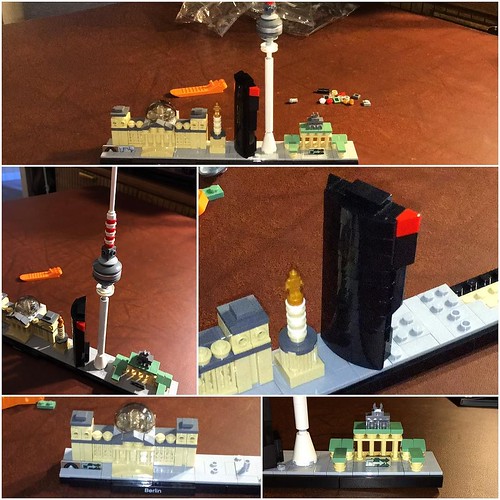
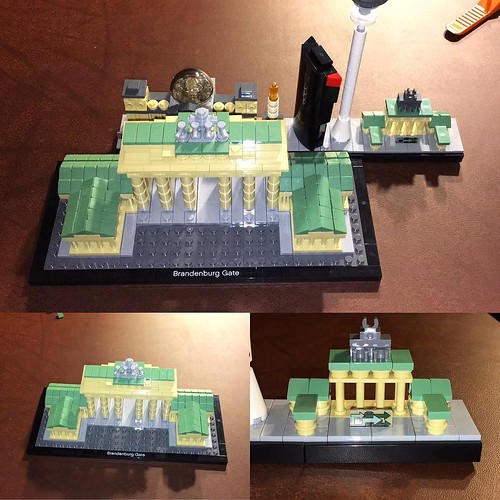
LEGO Architecture - Berlin & Brandenburg Gate

I figured I'd put together these two sets together.

BERLIN
Germany’s capital and cultural center dates back to the 13th century and has shaped – and been shaped by – many dramatic events in European history.

From humble beginnings as a medieval trading center, the city played a key role in the rise of the Kingdom of Prussia and modern Germany.

THE BUILDINGS:

BERLIN TV TOWER


The 1,207 ft. (368 m) tower consists of an 820 ft. (250 m) concrete shaft upon which sits a seven-story sphere, crowned by a 387 ft. (118 m) red and white striped antenna mast. It remains Germany’s tallest structure and a popular destination for almost 1.2 million visitors every year.

DEUTSCHE BAHN TOWER


Architect Helmut Jahn designed the eye-catching 338 ft. (103 m) semi-circular glass and steel tower, which was completed in June 2000. The office is now home to Deutsche Bahn AG, the German national railway company, and is referred to as the BahnTower.

VICTORY COLUMN


Originally erected between 1864 and 1873 to commemorate famous victories in wars against Denmark, Austria and France, the Victory Column (Siegessäule) was extended to its current height of 220 ft. (67 m) during the 1930s.

The sandstone column stands upon a base of polished red granite and is crowned with a 27 ft. (8.3 m) high statue representing Victoria, the goddess of victory from Roman mythology.

BRANDENBURG GATE


Commissioned by King Frederick William II of Prussia, the Brandenburg Gate was built as the grandest of a series of 18 city gates through which Berlin was once entered. Designed by architect Carl Gotthard Langhans and constructed between 1788 and 1791, the inspiration for the gate came from the entry hall of the Acropolis in Athens, Greece.

REICHSTAG


The Reichstag was originally completed in 1894, was almost completely destroyed during World War II and remained largely unused until the reunification of East and West Germany in 1990.

The renowned English architect Sir Norman Foster was given the task of renovating the building and chose to combine the original historical façade with modern architectural elements such as the spectacular glass dome.


I'm done.

Thursday, February 25, 2016

LEGO Architecture - Venice

This is one of three sets that LEGO debut in their Skyline series in the Architecture line. The Venice is the smallest of the three at 222 pieces. This is as miniaturized as you can get as far as LEGO bricks are concerned. They managed to fit 5 famous Venice landmarks.

Built on over 100 islands in a marshy lagoon at the edge of the Adriatic Sea, Venice has a skyline that rises from the water to create a unique architectural experience. There are no roadways or cars in the historic city; instead 177 canals crossed by over 400 bridges give access to innumerable narrow, mazelike alleys and squares.

THE BUILDINGS:

RIALTO BRIDGE


The Rialto Bridge (Ponte di Rialto) spans the Grand Canal at the heart of the historic city and was built between 1588 and 1591.

The single-span design with a 24 ft. (7.5 m) arch included three walkways: two along the outer edges and a wider central walkway between two rows of small shops. The entire structure was built on some 12,000 wooden pilings that still support the bridge over 400 years later.

BRIDGE OF SIGHS


Designed by Antonio Contino and completed in 1602, the Bridge of Sighs (Ponte dei Sospiri) is an enclosed bridge that passes over the Rio di Palazzo and connects the old city prison to the interrogation rooms in the Doge’s Palace.
The bridge’s romantic name is thought to refer to the sighs of convicts as they saw their last view of Venice before being taken to their prison cells.

ST. MARK’S CAMPANILE


The 323 ft. (98.6 m) tall St. Mark’s Campanile (Campanile di San Marco) stands alone in the corner of St. Mark’s Square, near the front entrance to the basilica. The brick structure is 39 ft. (12 m) wide on each side and 160 ft. (50 m) tall, upon which sits a belfry housing five bells.

ST. MARK’S BASILICA


St. Mark’s Basilica (Basilica di San Marco) is the most famous church in Venice and the best-known example of the city’s unique Italo-Byzantine architecture.
The current structure is thought to have been constructed between 1073 and 1093. The basilica is laid out in the design of a Greek cross and the tallest of the five domes reach 141 ft. (43 m) in height.

ST. THEODORE AND THE LION OF VENICE COLUMNS


Two granite columns stand guard at the entrance to St. Mark’s Square (Piazza di San Marco). Both columns are believed to have been erected in about 1268.
On top of the western column is a statue of St. Theodore, the first patron of the city. On the eastern column stands the winged Lion of Venice, the symbol of the second patron of the city, St. Mark.


I'm done.

Monday, August 31, 2015

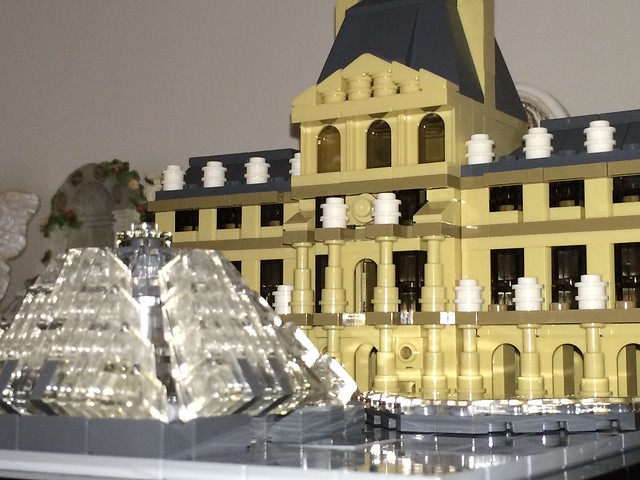
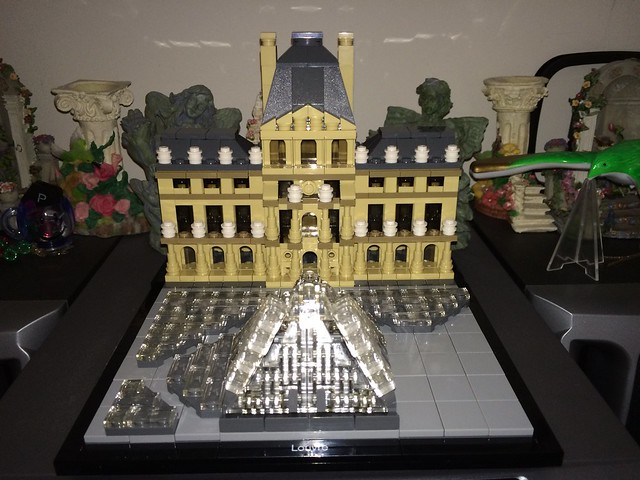
LEGO Architecture - Louvre

The last LEGO Architecture set for 2015 is of the Louvre museum in Paris, France. This set officially comes out on September 1st, 2015.


The Louvre, in it's many different forms, has dominated the city of Paris since the late 12th century. It was originally a fortress built to protect Paris. The dark fortress from the Middle Ages was continuously altered and expanded before being transformed into a Renaissance-style royal palace from 1546 onwards. The tranformation of the Louvre into the museum we know today began with the French Revolution.


Today, it is the most visited museum in the world, renowned for famous works of art such as da Vinci's Mona Lisa, as well as the building's spectacular Renaissance to Modernist architecture.


I'm done.

Friday, May 22, 2015

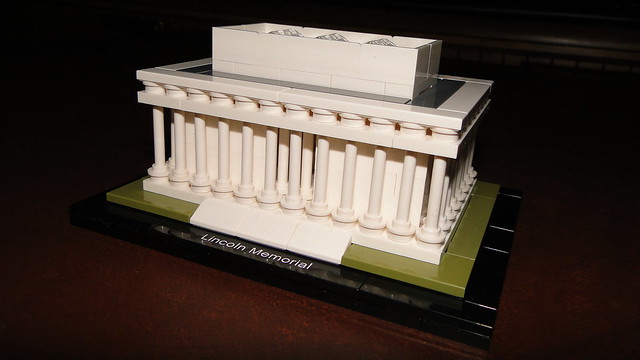
LEGO Architecture - Lincoln Memorial


Abraham Lincoln holds a unique place in the history of the United States: not only did he save the Union, he reinvigorated the nation’s founding principle — that all men are created equal. The campaign to erect a fitting memorial in his name began even as he lay on his deathbed in 1865. It would eventually be completed 57 years later, after decades of disagreements over what type of monument to build and where it should be placed.


The campaign to erect a fitting memorial for Abraham Lincoln began even as he lay on his deathbed in 1865. It would eventually be completed 57 years later, after decades of disagreements over what type of monument to build and where it should be placed.

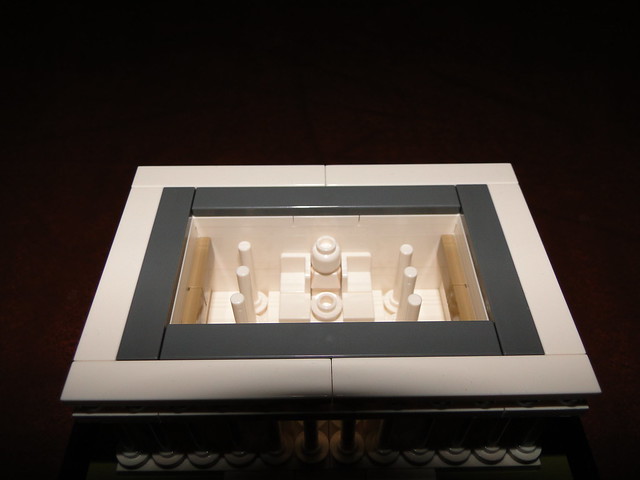
The memorial itself echoes a classic Greek temple and the structure measures 189.7 by 118.5 ft. (58 by 36 m) and is 99 ft. (30 m) tall. It is surrounded by a colonnade of 36 fluted Doric columns, one for each of the 36 states in the Union at the time of Lincoln’s death.


The interior of the monument is divided into three chambers. The north and south chambers contain carved inscriptions of Lincoln’s second inaugural address and his Gettysburg Address. Above each of the inscriptions is a mural portraying the governing principles in Lincoln’s life.

Between the north and south chambers is the central chamber containing the solitary figure of Lincoln sitting in contemplation.


I thought I'd make this set for Memorial day.

I'm done.

Tuesday, March 24, 2015

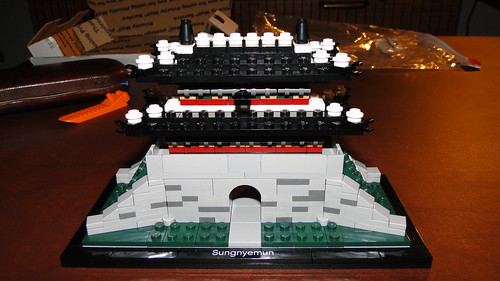
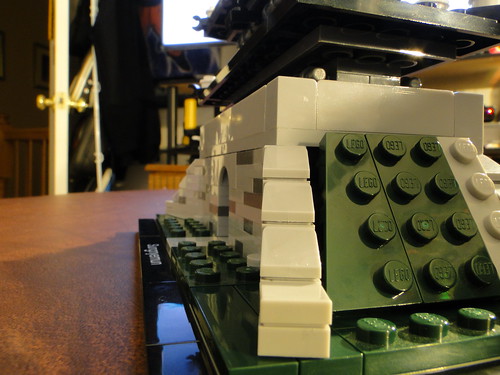
LEGO Architecture - Sungnyemun


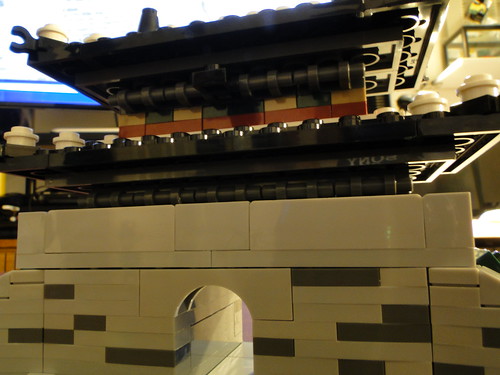
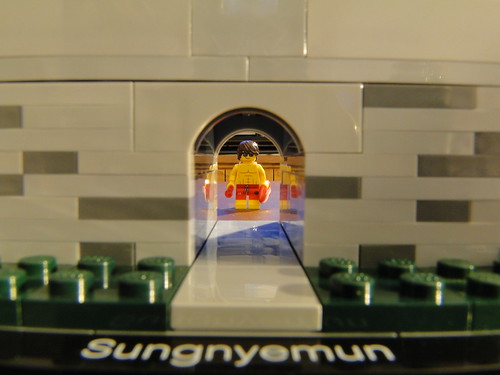
This set is one of two very limited LEGO Architecture sets they've produced. Released in June 2012, it was only available for less than 9 months until the LEGO company retired the set. I managed to find a seller on eBay and bought it used.


Sungnyemun (Gate of Exalted Ceremonies) stands majestically in the heart of the South Korean capital of Seoul. Seen as one of the most complete examples of Joseon Dynasty architecture in South Korea, the gateway is listed as the country’s foremost National Treasure.


Historical Setting


By the time King Taejo established the Joseon Dynasty in the late 14th century, the country that we recognize today as Korea was a kingdom in turmoil. Ruled by the faltering Mongol Empire, under attack from Japanese pirates and weakened by political intrigues, the kingdom needed a strong leader. Yi Seong-gye, later to become King Taejo, was a talented general who repelled foreign threats, gained independence from the Mongols and established the “Kingdom of Great Joseon” in 1392.

One of his first actions was to move the capital to Hanseong (Seoul) and initiate a building program that included a 6.1 m (20 ft.) high and 18.2 km (11.3 mile) long wall to protect the growing city. Four major gateways were built into the wall to control access in and out of the city, and Sungnyemun would become the most impressive of these gates. Sungnyemun consists of an imposing stonework base and archway with a two-story wooden pagoda construction sitting above.

Construction


The construction of Sungnyemun began in 1396 during the fifth year of the reign of King Taejo of Joseon and was completed in 1398. Taejo had ordered his architects to build the gate facing Mount Gwanaksan as a way of warding off the feng-shui fire energy associated with the mountain.

Further additions were made to the gateway in 1447 by King Sejong, the 4th King of the Joseon Dynasty, and further work was carried out in 1479 by King Seonjong, the ninth King in the dynasty. It was at this point it was given the design that we still associate with the gate today. At that time Sungnyemun was already the finest of all the gateways intothe city, and the stone and two-tiered wooden structure with a pagoda-shaped tiled roof rose high above the rest of the city.

Further alterations and renovations continued over the next 600 years. The walls on both sides of the gate were removed in 1907 to make way for a tramway. During the Korean War (1950-1953) Sungnyemun suffered damage from bombing. In 1962 the gateway was officially designated as Korea’s first national treasure and an extensive reconstruction program was carried out.

During the work that was carried out on Sungnyemun in 1962, hidden records were discovered under a ridge beam of the second roof. These placed the precise date of the original construction as 1396 and went on to record that 6,817 soldiers were conscripted to perform the manual labor. The inventory also listed that twenty-eight stonecutters, forty-four carpenters, sixty-three riveters, and five sculptors, along with 1,400 laborers took part in the gate’s construction. The record even detailed the feast at the beam-raising ceremony: 10,700 bottles of Arak-Ju (Korean rice-based grain liquor), 3,800 barrels of Tak-Ju (traditional Korean wine), and 1,500 head of cattle.

Sungnyemun Today


Once the tallest building in Seoul, today, Sungnyemun is surrounded by the skyscrapers and bustling traffic of a modern city. The gate provides a visible contrast between ancient and contemporary Korea, and is one of the few physical links to the Joseon Dynasty.

The pagoda building on top of Sungnyemun was the oldest existing wooden structure in Korea until February 10, 2008, when fire totally destroyed it. A complete restoration project began two years later in 2010 and it’s expected that an exact reproduction of the original will be completed by the end of 2012.

The entire reconstruction is being carried out using traditional methods. Conventional hand tools are made in a smithy set up on-site and workers wear ‘hanbok’, the traditional Korean costume, when working on the gate. As much timber as possible from the surviving frame is being recycled and put together with wood from dozens of pine trees to become pillars of the new structure.

A traditional ritual was performed at a ceremony prior to the start of construction, praying for a smooth restoration process as well as protection from further disasters to Korea’s most important National Treasure.

Facts about Sungnyemun


Location: Seoul, South Korea
Architect: unknown
Style: Joseon Dynasty
Construction type: City Gateway
Construction materials: Stone base with wooden structure
Date: 1396-1398, Rebuilt 1447 & 1479
Size:
  • Stone base - 28.97m x 14.79m
  • (95.05 ft. x 48.52 ft.)
  • Wooden structure - 22.29m x 7.65m
  • (73.13 ft. x 25.1 ft.)

LEGO Architecture launches its model of Sungnyemun as a celebration of the EXPO 2012 exhibition in Yeosu, South Korea.


I'm done.

Friday, March 13, 2015

LEGO Architecture - First Three Sets

I recently obtained a retired LEGO architecture set (John Hancock Center). I decided to take apart the Willis Tower (Sears Tower) and Empire State Building sets and create a timelapse for it.


21000 - Willis Tower (Sears Tower)

The Willis Tower,located in the heart of Chicago, is an “international style” design consisting of square tubes in a 3 by 3 tube arrangement, with each tube having a footprint of 23 meters (75 ft.) by 23 meters (75 ft.), in essence creating a unified bundle of nine tubes. The Willis Tower was the first building for which this type of “bundled- tubular” construction was used. This design provides stability against high winds and also allows for future upward growth if so desired.

The building is supported by 114 rock caissons secured into bedrock. The foundation and the floor slabs combine to equal 2 million cubic feet of concrete. 76,000 tons of prefabricated steel frame sections measuring 15x25 ft. were put in place. The Willis Tower has more than 16,000 bronze-tinted windows and 28 acres of black aluminum cladding or “skin”.

As the building climbs upward, the tubes begin to drop off giving the Willis Tower its characteristic setback or “step-back”. This geometry of the 110-story tower was developed in response to the original interior space requirements of Sears, Roebuck & Company.

21001 - John Hancock Center

The John Hancock Center is one of the most famous buildings representing the structural expressionist style; the skyscraper's distinctive X-bracing and angular facade has made it an architectural icon not only in Chicago, but throughout the world.

The X-bracing exterior is actually a hint that the structure's skin is part of its tubular structural system. This "diagonalized trussed-tube" is essentially the spine that helps the building stand upright during wind and earthquake events. This is one of the architectural techniques building used to climb to record heights which eliminated the need for inner support beams, greatly opening up the floor plan and increasing the usable floor area.

The overall form can be described as truncated rectangular-pyramid. Shaped like a rhombus or rhomboid, and essentially a parallelogram with unequal adjacent sides in this case composed of four trapezoidal planes.

21002 - Empire State Building

During the Great Depression, America’s labor force was at its highest supply and the value of the dollar was cut in half over night. Ironically, it was this combination of events that made a construction project of this proportion possible.

Built on the previous site of the famous Waldorf Astoria Hotel, the construction took seven million man-hours and had a feverish pace of 41⁄2 floors per week.
Ironworkers erected 60 thousand tons of riveted steel frames into a series of stacked boxes. They became known as “Sky-walkers” due to the dizzying heights they worked at – heights never previously attempted.

On May 1st, 1931, the building opened after only 410 days of construction and it remained the tallest building in the world until 1972 when the World Trade Center opened. The building has been named one of the 7 wonders of the modern world.


I'm done.